
How Generative AI Is Rewiring Supply Chains for Resilience, Agility, and a Whole New Competitive Edge
Our comprehensive annual research reveals how leading organizations are leveraging generative AI to drive innovation and competitive advantage across increasingly volatile global supply networks.
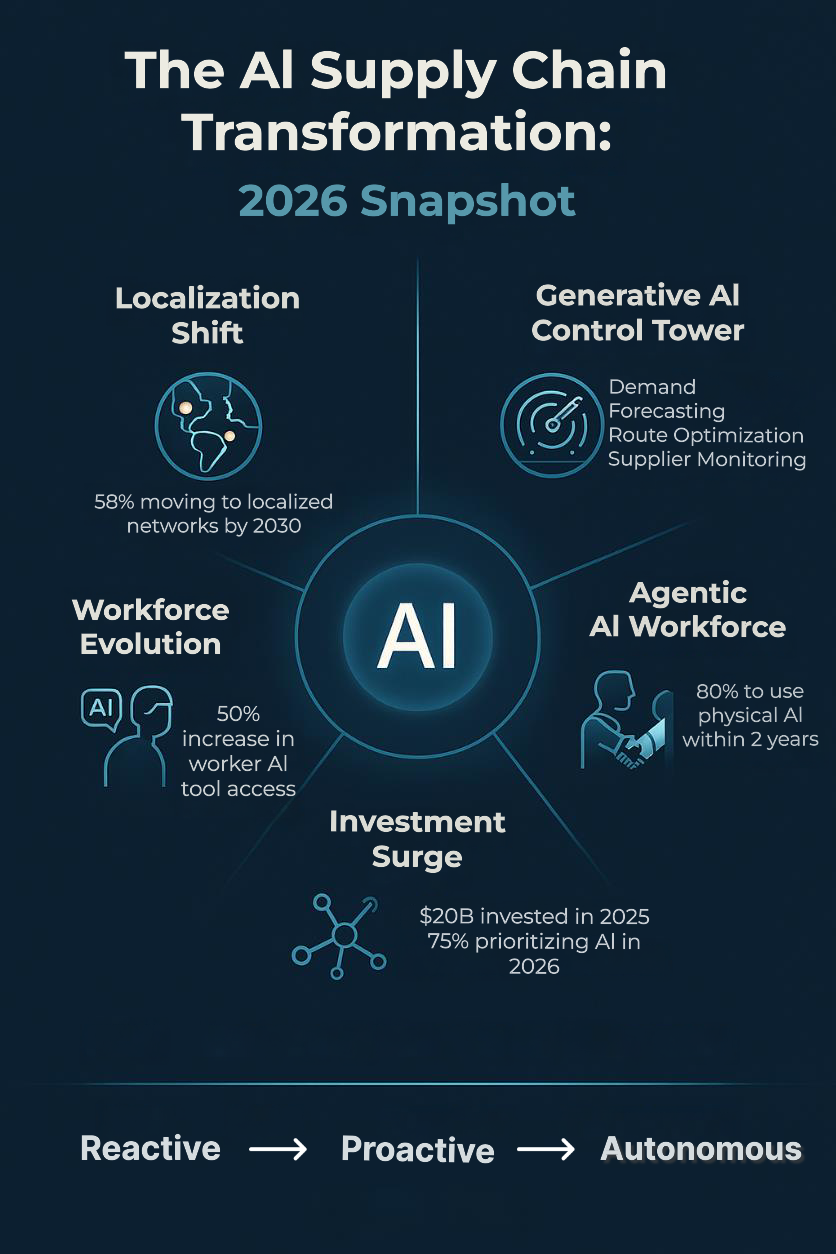
If the last decade taught leaders anything, it's that supply chains no longer behave like tidy linear sequences. They behave like dramatic TV series—full of unexpected plot twists: geopolitical tension, climate events, tariff spikes, shipping bottlenecks, cybersecurity shocks, and demand curves that refuse to behave.
Good news: AI is finally becoming the reliable supporting character every enterprise needs.
By 2026, leaders aren't wondering if AI can help manage this chaos—industry reports reveal they're betting heavily that it can.
Supply chains are being reimagined—from reactionary systems to proactive, predictive, and autonomous networks. Welcome to the AI-powered enterprise.
Enterprises are realizing that long, globe-spanning networks are increasingly difficult to control. The shift isn’t away from globalization—but toward strategic localization. And AI is the quiet force that makes this shift possible, with organizations increasingly leveraging AI/ML solutions by:
This marks a transition from "produce anywhere, deliver everywhere" to "sense everywhere, produce strategically." Many of the strategic leaders GoldFin works with have described these changes, saying things like:
In practice, this means supply chains become more regional, more nimble, and—thanks to AI—far more aware of themselves. It feels less like managing a machine and more like tending a living ecosystem.
Generative AI isn't just creating documents—it's orchestrating decisions.
Research shows applications already becoming mainstream across:
Models use historical sales, promotions, economic signals, and real-time factors to generate highly accurate, scenario-based forecasts.
Real-world impact: Amazon's AI forecasting systems dramatically reduce stockouts and enable some of the world's fastest inventory turnover.
Generative AI continuously models route scenarios using traffic, weather, and fuel data.
Real-world impact:
Microsoft's Dynamics 365 Copilot aggregates global supplier news, flags geopolitical or environmental disruptions, and automatically drafts supplier communications.
Generative AI is becoming the always-on nerve center for the enterprise.
Deloitte's 2026 AI Outlook highlights a major shift: AI agents are moving from concept to production.
These agents can:
Manufacturers deploying agentic AI report significant visibility improvements and speed-to-decision advantages.
Yet only one in five companies has mature governance models to control autonomous agents—meaning 2026 is also the year enterprises learn to put guardrails on their digital coworkers.
Not just software—hardware is getting smarter too.
According to Deloitte's research:
Examples include:
Together, these technologies shrink lead times, lower labor strain, and boost throughput—turning warehouses into living, learning systems.
The Global Value Chains Outlook 2026 reveals that supply chain design has undergone a philosophical shift.
Organizations are moving from execution to value orchestration—from linear chains to adaptive, sensor-driven value networks.
Key forces shaping this shift include:
AI investment in supply chain operations reached $20 billion in 2025, showing its centrality in competitiveness.
The new supply chain playbook isn't just about responding faster—it's about designing systems that adapt themselves.
AI isn't replacing the supply chain workforce—it's upskilling it.
Deloitte's 2026 State of AI report shows:
Teams will increasingly partner with AI:
The supply chain professional of 2026 is part analyst, part conductor, part technologist.
Let's imagine a typical morning in a 2027 AI-powered enterprise:
This isn't sci-fi—it's next year.
In 2026, AI-powered supply chains shift from being a competitive advantage to a competitive requirement. Winners will distinguish themselves not by using AI, but by orchestrating entire ecosystems around it.
This future is more local, more autonomous, more predictive—and a lot more fun for leaders who embrace it.
Discover how GoldFin Solutions can help you leverage AI to build resilient, adaptive supply networks.
Schedule a Consultation